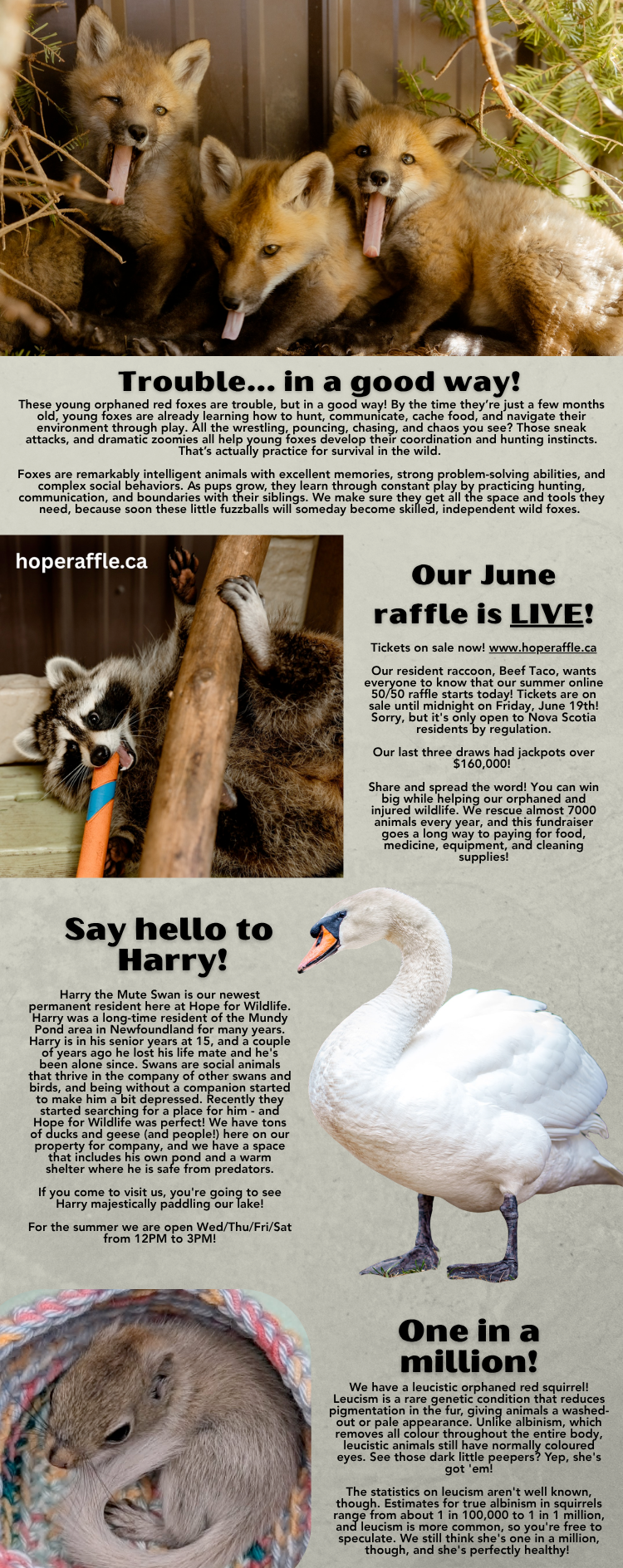
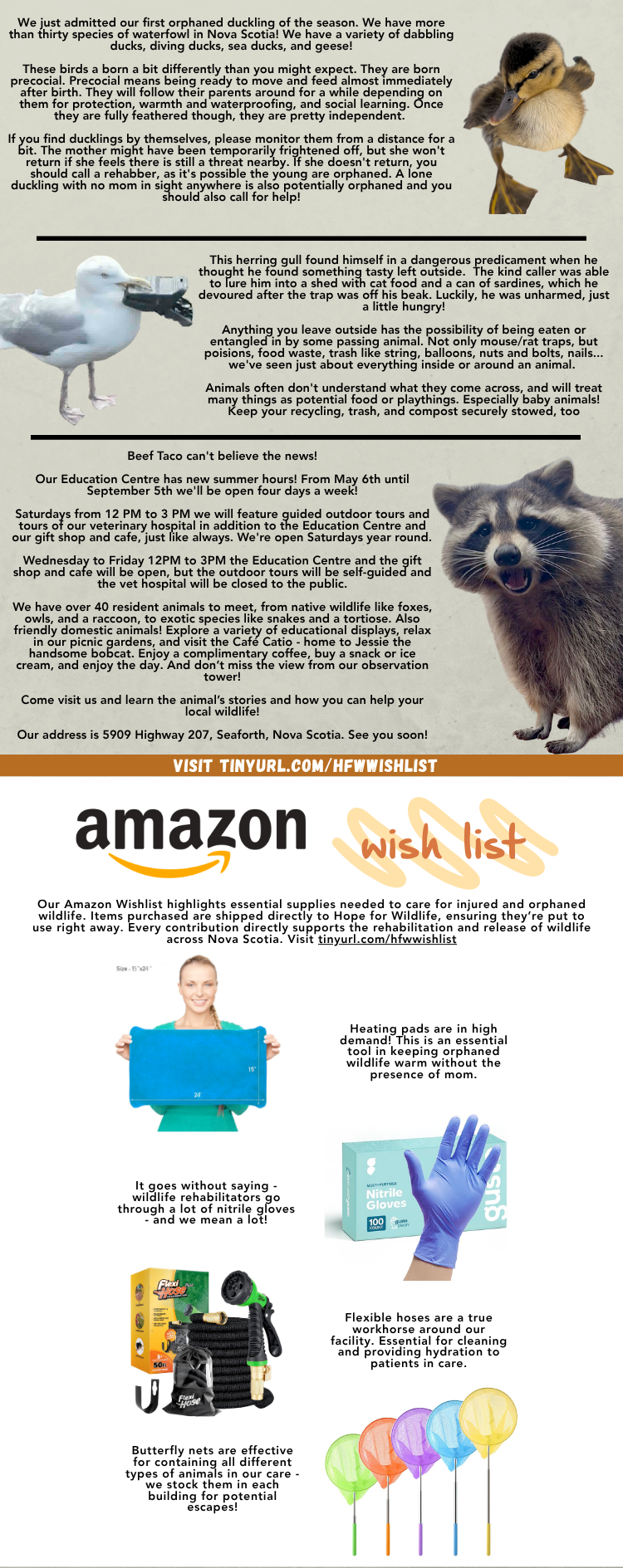
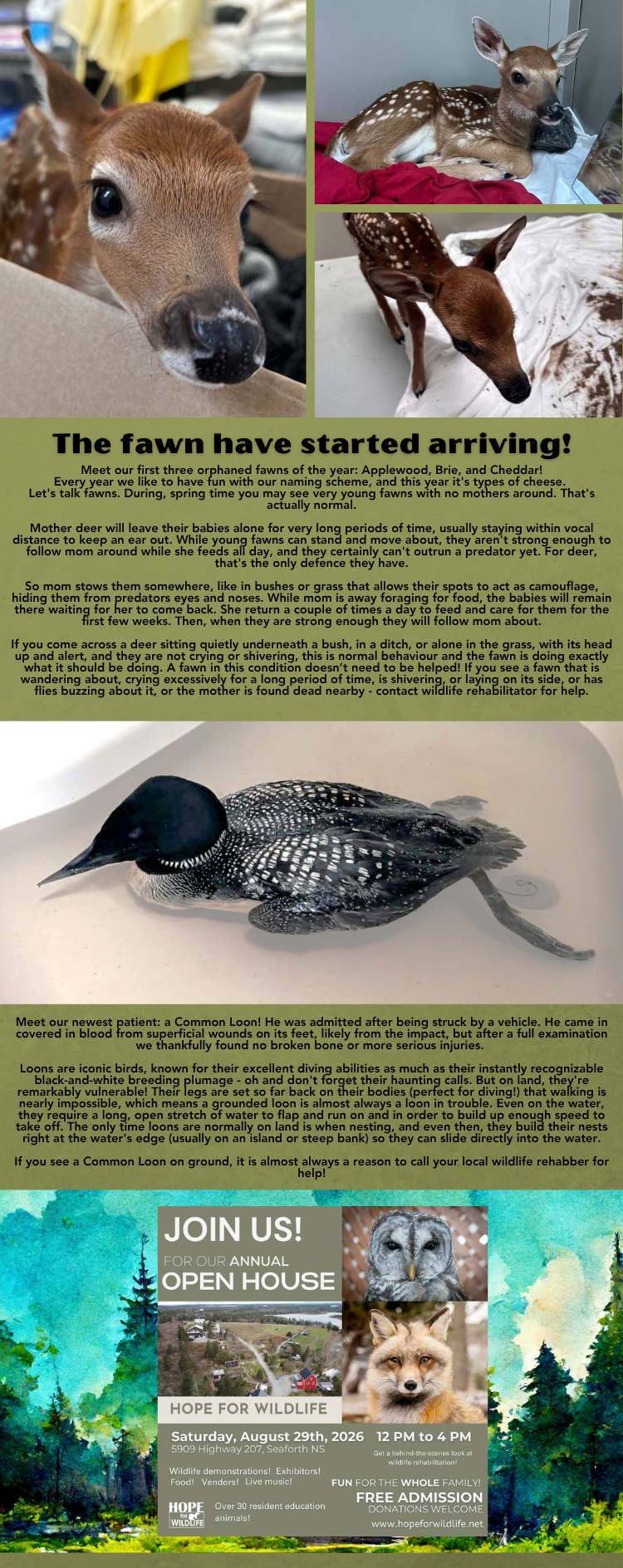
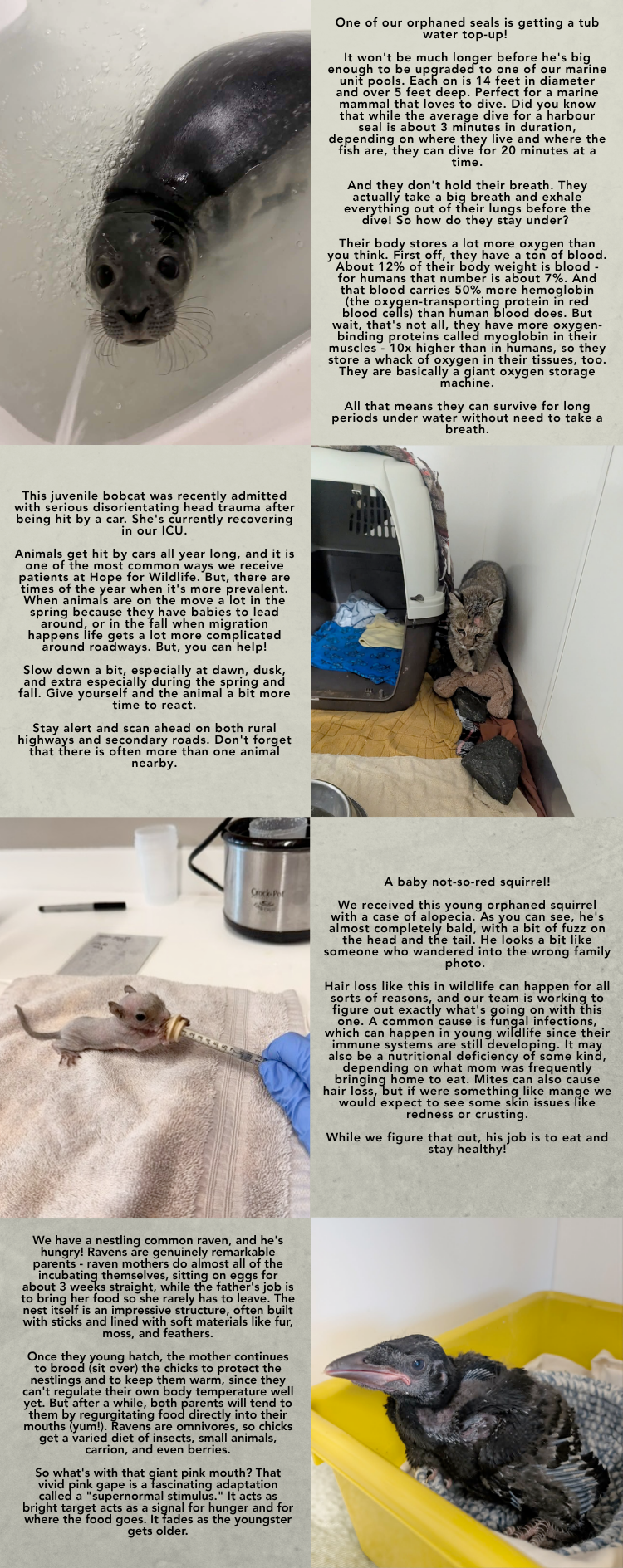
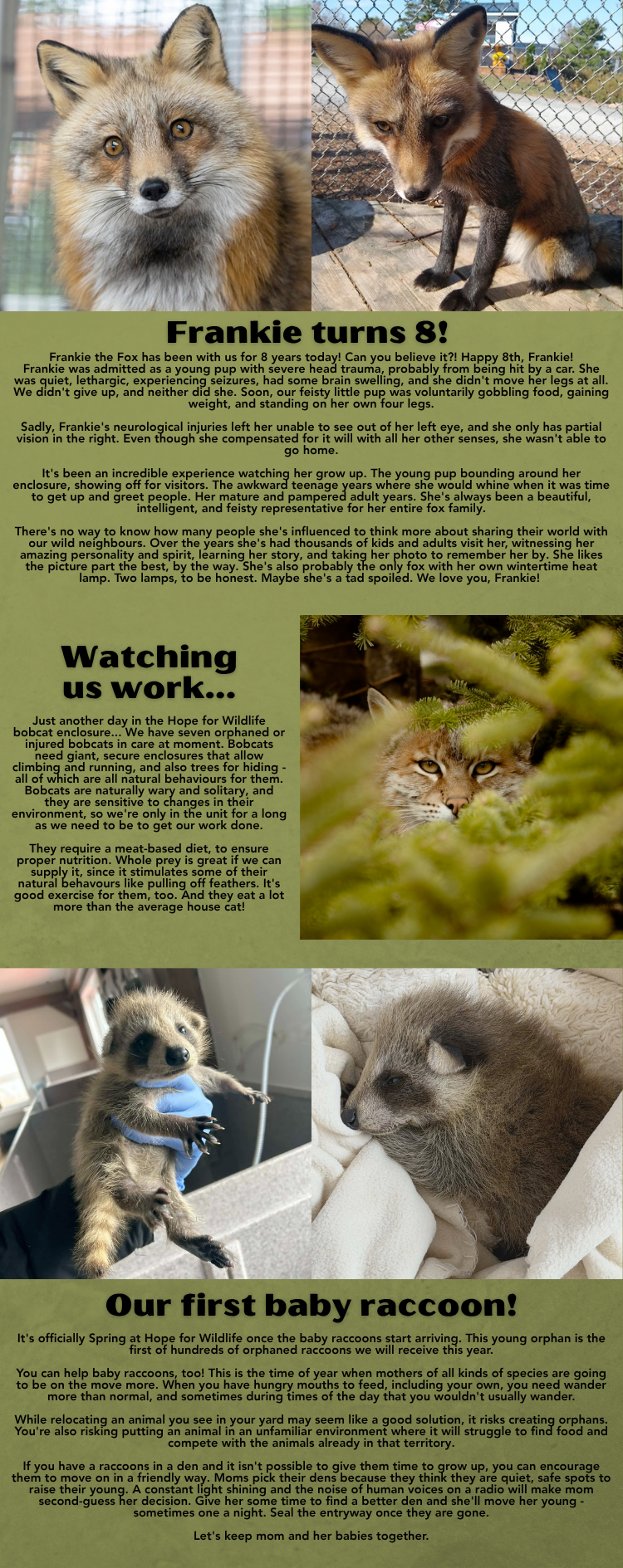
Check Out Some Hope for Wildlife Videos!Harry takes a dip! Our newest resident, Harry the Mute Swan, takes his first dip in our lake. If you come to visit us, you're going to see Harry majestically paddling our lake! Click HERE to see Harry’s First Dip ____________________________________________________________________ There's no place like home! After being in care for over 200 days, this Eastern Painted Turtle is now back home. He was hit by a car and arrived with a fracture and a crack in his shell, as well as lacerations to his tail. After healing up and spending the winter with us, the weather is now perfect for him to get back to his lake. If you see injuries, or you need help to move the turtle, call a rehabber! Click HERE to see the Eastern Painted Turtle release ____________________________________________________________________ Teach a seal to fish... The poor orphaned harbour seal pup was admitted in late April as an infant male after being found next to his deceased mom. He was so young he still had is umbilicus cord. His condition wasn't good, and he sounded like he had already had possible aspiration pneumonia. He's had a long road already, being tube-fed colostrum, rehydration therapy, constant regular feedings... but, he's been improving! He's now getting regular tub swimming exercise to help build up his strength, and hopefully soon he'll be big enough and strong enough to move outside to one of our marine units. Harbour seal mothers do leave very young pups alone at haul-out sites while they forage for food, so a lone harbour seal pup is not that unusual to see. Healthy pups are plump and round like a big fat sausage. If they have visible skin folds or look long and skinny, or they are vocalizing for long periods of time and approaching people, that's a sign that you should call a rehabber to come and have a look. Click HERE to see the Harbour Seal learn to fish ____________________________________________________________________ Feeding time! The babies are continuing to arrive. We have dozens of baby raccoons at the moment, so we hauled out the bottle rack to help with the feeding. Some of them need more help than others. Click HERE to see our baby Raccoons take a bite ____________________________________________________________________ Everyone needs to eat! Well, baby season is now in full swing at Hope for Wildlife. It won't be long before the feeding and cleaning routine gets played out for hundreds of baby animals four or five times a day for each young one! It's hard not to love a red squirrel. Adorable and playful when young, and when they grow up they are so incredibility feisty. This young squirrel will soon be yelling at everyone from the treetops. Red squirrels might be small, but they are extremely territorial, and they’ll loudly scold animals much bigger than themselves if they are in their space. But not necessarily their neighbouring squirrels, though - or at least not as much! Scientists have found red squirrels recognize the voices/calls of neighboring squirrels and treat them a bit differently than strangers. It’s often called the “dear enemy” effect! They tolerate known neighbors more because their neighbours already know the boundaries and routines, while unfamiliar squirrels or animals are treated as bigger threats. So, they'll still scold you with loud chatter, but it's more of a refresher on the rules. Click HERE to see an orphaned Red Squirrel gobbling back some formula ____________________________________________________________________ Love is in the air! A pair of pigeons in the rehab decided to start making a nest. Pigeons often build very minimal nests, sometimes just a loose platform of sticks. It can look inadequate, but it’s typical for the species because they are cliff nesters by nature, and all they need to do is make sure the egg doesn't roll away. Pigeons are biparental incubators, which means both adults will incubate, with the male usually taking the daytime shift, and the female overnight. After about 17–19 days, the baby pigeons, known as squabs, hatch! Click HERE to see our Pigeon pair making a nest
|