|
$$PLAIN_TEXT_PREVIEW$$
|
|
2023 Hope for Wildlife Annual Open HouseDonations Request for Silent Auction Hope for Wildlife Society's annual open house is scheduled for August 26th from 12-4PM. We welcome 1000’s visitors each year to our rehabilitation centre, providing a unique "behind-the-scenes" experience of wildlife rehabilitation in Nova Scotia. As a non-profit charitable organization, we rely solely on grants and donations to sustain our operations. We are not government funded and operate with a small team of dedicated staff and volunteers. Your contribution of goods or services for our auction would greatly support our efforts. Since our establishment in 1997, we have successfully rescued, rehabilitated, and released over 80,000 injured or orphaned wild animals, representing 250 native species. Our patient intake has been steadily increasing, with a record-breaking 7000 wild patients cared for in 2021. By donating, you directly assist in rescuing and rehabilitating injured and orphaned wildlife across Nova Scotia. You can have an item picked up by texting 902-407-9453, or you can drop or mail your item to our address: 5909 Highway 207, Seaforth, Nova Scotia, B0J 2L0 We sincerely hope you will consider contributing; and please join us at the event. Yours Sincerely, Hope Swinimer Founder & Director, Hope for
Wildlife Society ...because they matter. |
|
Click the image above to watch the release!
|
|
|
Hope for Wildlife’s 50/50 Raffle is now open. Tickets on sale now until August 18th. The draw will take place on our Facebook Page August 19th. Click the button below to purchase your tickets.All proceeds go to support helping Nova Scotia wildlife. |
|
|
|
|
Hook…Line….ReleaseA couple of weeks ago this bald eagle was reported to us, dragging a wing and unable to fly on a local beach. When we investigated, we discovered that it had a huge fish hook embedded in it's left wing that had caused a bit of damage. We removed the excess fishing line and brought the eagle in for fish hook removal and medical care. Unfortunately, entanglement with fish hooks and fishing line is common for many sea birds. Amazingly, after a couple weeks of meds and treatment, this eagle was flying strong and ready for us to get him back home! So we did just that! You can view a video of the release by clicking the image above! |
|
|
|
|
|
Bath Time!Apart from cooling off from the heat, bathing is important for a bird’s survival - even in winter. Dirt, parasites, bacteria, and other debris can cause their feathers to become damaged over time, and bathing helps to keep those feathers in good condition. Those pests and bacteria may even cause infections and disease. Wetting, or even just dampening the feathers loosens the dirt and makes their feathers easier to clean and then to preen. When preening, birds carefully rearrange the feathers and spread oil on them from their preen gland so the feathers remain waterproof. That also helps to create an insulating layer of air underneath the feathers to keep them warm when needed. In the wild, a bird may bathe during a rain shower, in a puddle, a lake, or a stream. Some birds even nuzzle playfully in wet grasses and vegetation. You can watch them flap around in the tub, click the image above. |
|
|
|
|
Whatcha Building?Baby beavers are curious animals who are always interested in whether what you are currently holding would make good material for a dam, and often enjoy testing their theory. You can almost see these little beaver kits working out the math in their head. Dam building is innate behavior in beavers. While they refine their techniques as they gain experience, and they can learn from their parents and older siblings, young beavers who had never even seen a beaver dam are able to construct dams and lodges! |
|
|
|
|
There are lots of ways you can help Hope for Wildlife. Please check out Our Site under support us |
|
|
|
|
|
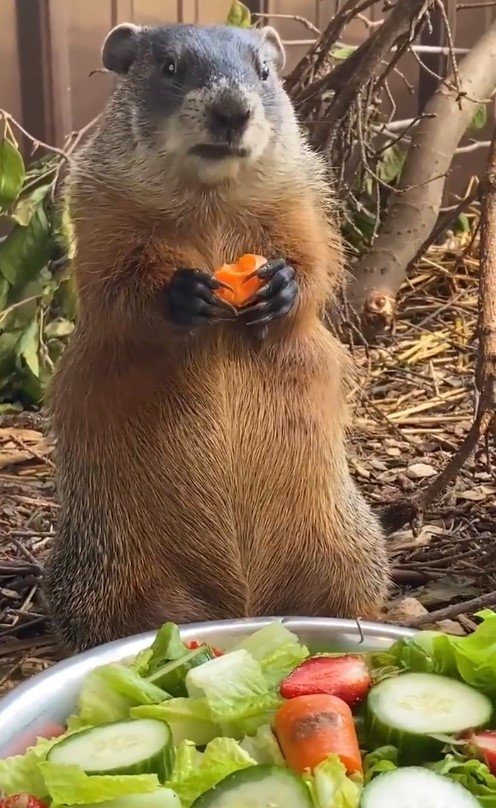
Put the Camera Down….and get some more carrots! While it's always adorable to watch groundhogs double-fisting a hunk of veggie, it's important to keep in mind you're watching a useful intermediary in our ecosystem at work. Primarily herbivores, groundhogs eat a variety of plants - but they also may eat things we consider pests, such as grubs, other insects, and snails. Their huge burrows are not only potentially helpful to soils for aeration and nutrient recycling, but they are often used by other animals as dens. And if being painfully cute doesn't make you jealous enough, mother groundhogs have a very short pregnancy term - it's only a month long! Click the pic to watch this groundhog snack! |
|
|
|
|
|
Look Waaaay Up!Our baby porcupine is using our enrichment trees to practice a valuable skill - climbing! Porcupines may be slow-moving, but they are surprisingly agile, and they are great climbers. They have muscular legs, curved claws, and a strong tail, all of which enables them to effortlessly climb the trees. This little porcupine will need to become a great tree climber so that he can find food and escape from some predators. While they may be equipped with quills which form a great means of defense, nothing beats the hide-in-a-tree approach. |
|

|
|
|
|
|
|
|
|
Save A Life - Secure Your Green Bins!Unsecured green bins can be deadly for raccoons, especially at this time of year. Raccoons often get in easy, but getting back out can be considerably harder, especially if they are too small. Then, in the extreme summer daytime heat they become dangerously dehydrated very quickly - many die as a result. Raccoons are curious animals and the smells coming from the types of household compost bins used for municipal pick-up can be irresistible to them. Thinking they are a good place to eat and sleep for the night they can get trapped in them. They can also easily become disoriented by inhaling the fermenting fumes of compost and may end up becoming too lethargic to get out. The best way to prevent animals from getting into your green bin is to secure the lid down tightly with a thick rubber bungee cord that they can't pry off or chew through. The lid needs to be secure enough that the animal can't pry it open at all. If you can't open it easily, they probably can't open it at all. Make sure to check your green bins frequently to make sure no critters are inside. If you do find a raccoon or any other animal trapped in your green bin, please call your local wildlife rehabilitator |
|
|
|
You are our Inspiration!It is because people care that makes the work we do so important.Please consider making a donation today. You can make a one time donation or become a monthly donor.
|
|
|
|
|
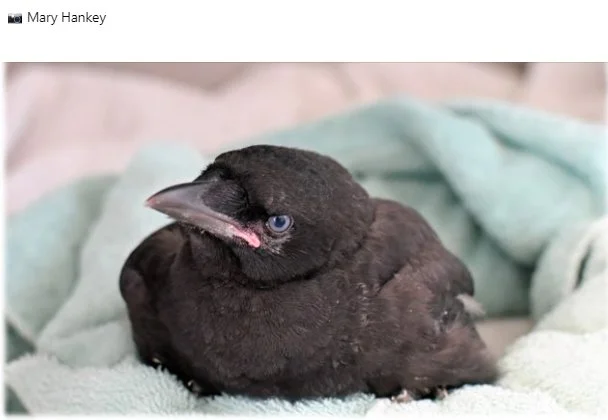
Baby blue eyes!Did you know that juvenile American Crows have blue eyes? As they mature, their eye colour will change to brown. Their eye colour is helpful for identifying crows on the ground that are fledglings. People are often surprised that most young birds don't fly out of the nest; rather they come to the ground for a few days, either finishing growing their flight feathers or getting strong enough to get off the ground. While it does make them vulnerable, it's actually less vulnerable than staying in the nest! We may think of nests as a safe place to be, but predators have a pretty easy time finding a crowded nest full of loud baby birds, so the sooner they leave the nest the sooner they can spread out and hide while being tended to by parents. So if you see a feathered crow on the ground that can't seem to fly, have a quick look at the eye colour. Another feature to look for is a tiny bit of pink left at the corner of the crow's mouth, called the gape. Also look around for parents - they are usually nearby. As long as the parents are tending to them and there are no obvious injuries, they are probably fine! If the baby bird is sparsely feathered with lots of down showing, and is not capable of hopping, walking, or fluttering around, it may a nestling that is too young to be on the ground. Give your local wildlife rehabilitation center a call for advice! |
|
|
|
Hope for WildlifeGiftshop
|
|

|
Ladies regular fit 100% preshrunk cotton oval neck Tee, comfortable & stylish. CA$20.00
|
|
|
|
|
|
Makes a great gift especially for your binge watchers out there. Every season is here from Season 1 to Season 10! CA$30.00
|
|

|
|
|
|
|

|
Take your support on the road with this wildlife warning system; as air rushes through this small device, a high-pitched whistle is produced that only animals can hear, alerting them of your approaching vehicle. Includes two whistles (one set). CA$10.00
|
|
|
|
|
|
Avoid window strikes with these beautiful prismatic bird warning decals. They stick to the window with static so no damage to windows. They can be used for years and never fade. There are enough decals in each pack for effective window coverage. CA$20.00
|
|

|
|
|
|
|
|
|
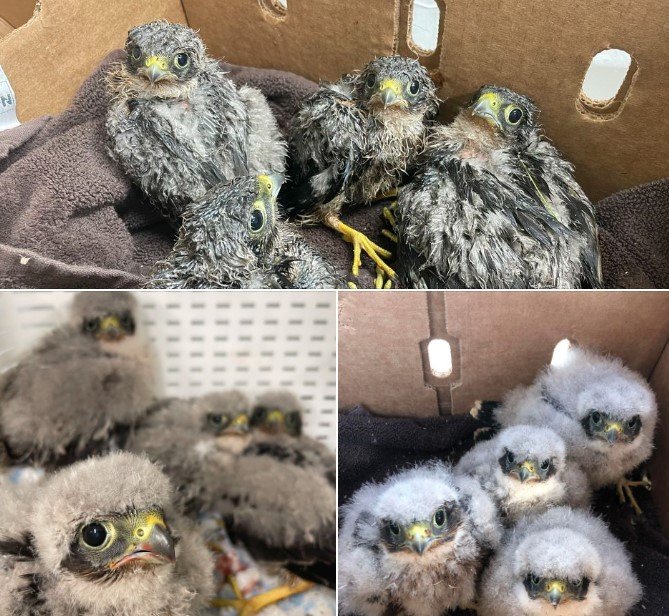
Some people got a bit of a surprise the other day when they cut down a tree before they noticed that some merlins had a nest in it. The babies came in a bit wet from the rain, but otherwise unharmed. The adorable little ones fluff up quite a bit when dry! Merlins are a small species of falcon, with a more broad and stockier build than their more often seen cousins the american kestrels. Most merlins will use abandoned corvid or hawk nests which are in conifer or mixed tree stands. Being not too selective, some will also set up a nest on cliff faces and even on the ground. It can sometimes be difficult to see bird's nests in trees, especially because many bird species build them so they are not easy to find. But a little patience and through searching before cutting a tree down can be very helpful to our bird populations. These little ones only had about three weeks to go before they would have left the nest and fledged. |
|
|
Remember Ember and Ash?They were the two newborn fawns saved only a few feet from the wildfire that was raging near Shelburne. They are doing great, and as you can see they love to stick together, playing and hiding in our deer enclosure. They also have 16 other orphaned fawns to keep them company. It's quite the herd! Doe deer will often leave their fawns hidden in a safe spot while they forage for food nearby - usually for many hours at a time, and a fawn's instinct is to lie in a safe spot like tall grass and hide from predators, waiting for mom to come back and feed them a couple of times a day. So it's very important that our deer enclosure have tall grass for them to hide in. This helps them feel safe. |
|

|
|
|
|
|
|
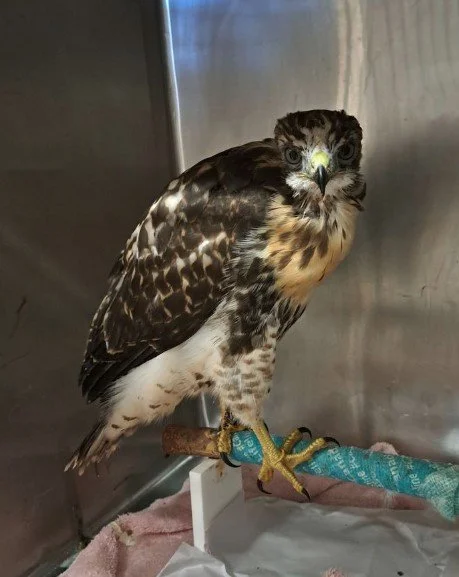
This fledgling red-tailed hawk arrived the other day after being observed without a parent around for a couple of days. Upon examination, we discovered she was pretty thin and dehydrated. We'll keep her well fed until she gets stronger and grows in all of her flight feathers. They don’t get their namesake red feathers until the start of their second year, instead sporting these brown tails. Adult red-tailed hawks make a majestic call that will sound familiar to you because Hollywood loves it. Whenever a bald eagle appears on screen, the cry you hear is a red-tailed hawk! Though the bald eagle looks intimidating, it makes a rather non-intimidating series of squeals. |
|
|
Did you know that Hope for Wildlife has an Amazon Wishlist . As we continue to rehabilitate more and more animals, the supplies we require grows. Check out our wish list to see if you can help.Items from the Amazon wish list will be shipped directly to Hope for Wildlife5909 Highway 207, Seaforth, Nova Scotia , B0J 2L0
|
|
|
|
|
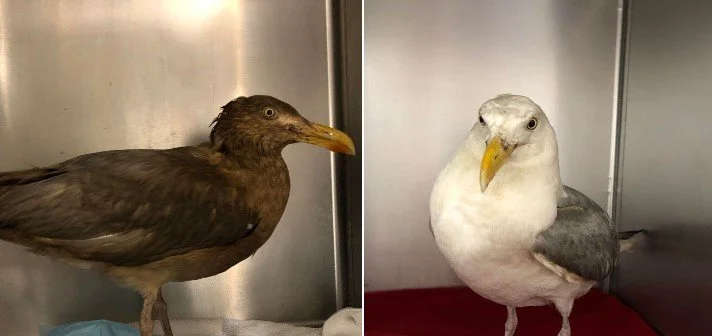
Before and After!This herring gull was found covered in what we believe is cooking oil from a fast food restaurant. Famous for their love of french fries, it's actually very common for gulls (as well as other birds and animals) to fall into used cooking oil that is unsecured. She was pretty filthy, and a bit thin and dehydrated, and had feather damage - probably from repeated trying to fly. But after a good bath, some meds, and a lot of time for recuperation we think she'll be okay. Her appetite has definitely returned - but this time we are feeding her food much more nutritious than french fries. |
|
|
|
|
|
|